
Understanding Hocking County Releases
“Released” means custody changed, but it does not name one outcome. A person may leave the Southeastern Ohio Regional Jail after posting bond, receiving recognizance, completing a jail term, or obtaining dismissal. The court may place someone on community control, Ohio’s term for court-supervised probation. A sentenced person may instead be transferred to the Ohio Department of Rehabilitation and Correction. Other movements can lead to another county, federal authority, immigration custody, or medical care. Escape and death also remove a name from an ordinary roster, yet neither is a community release.
The record path follows the event. A direct community release is best confirmed by the jail’s dated release or movement entry and the court order that authorized it. A state-prison transfer shifts current custody research to the ODRC Offender Search. A VINE notice may add timely event information, but it does not replace the source record. The key is to learn both that custody at SEORJ ended and where the person went next.
| Custody outcome | Meaning | Best next source |
|---|---|---|
| Bond or recognizance | The case continues outside jail. | Hocking court order and SEORJ release entry |
| Time served | The jail portion of a sentence is complete. | Sentencing entry and jail discharge record |
| Community control | The Common Pleas Court supervises conditions in the community. | Court docket and Hocking probation office |
| ODRC transfer | The person left regional custody but remains confined. | ODRC status and prison record |
| Parole or post-release control | State custody ended under Adult Parole Authority supervision. | ODRC Released or APA Supervision detail |
| Other-agency transfer | Custody moved rather than ended. | Receiving agency named in the movement record |
Hocking County Release Record Fields
A Hocking County release record may be a set of linked entries rather than one certificate. The booking record establishes who entered custody and why. A release or movement entry records how that stay ended. The court docket supplies the legal authority. Together, these records can distinguish a community release from transport to another agency. Ohio law requires a jail register to include each prisoner’s name, the date and cause of commitment, and the date and manner of discharge under Ohio Revised Code 341.06.
| Field | What it shows |
|---|---|
| Name, birth data, Jail ID | Connects the release to the correct booking and reduces mistaken identity. |
| Book date and arresting agency | Identifies the custody episode and separates Hocking cases on a five-county roster. |
| Charges, court, and case number | Links the jail event to the court that issued release authority. |
| Release date and time | Marks when custody at the releasing facility ended. |
| Reason or disposition | May identify bond, completion, dismissal, court order, or another basis. |
| Receiving agency or destination | Shows whether the event was a transfer instead of community release. |
| Booking photograph | Documents appearance at booking, not guilt or present status. |
The live SEORJ roster carries a different set of current-booking fields: Jail ID, photo, name, charges, court, disposition, bail, SID, book date, attorney, next court date, and arresting agency. It has no observed release-date column. That difference matters. Current roster data can identify the right booking, but the historic release or movement entry supplies the end of custody.
Request Hocking County Release Records
The Hocking County Sheriff’s official contact page links to the public-record request channel. The dedicated policy also accepts in-person requests on weekdays during its published office hours. Because SEORJ is a regional facility, the Sheriff may hold Hocking arrest or investigation records while SEORJ holds the jail booking and release data. A clear request names the record, person, booking, and date range instead of asking for every possible file.
- Gather the full name, aliases, date of birth or approximate age, Jail ID if known, arrest date range, arresting agency, and court case number.
- Ask for the booking sheet, dated release or movement entry, release reason, receiving agency when transferred, and booking photograph.
- Use the Sheriff’s official records-request channel for Hocking records and contact SEORJ for jail-maintained data if needed.
- Request electronic copies and an advance cost estimate. Do not assume one flat release-record charge.
- Compare the response with the latest court order. If it identifies a transfer, continue with the named receiving system.
The Sheriff’s policy effective May 1, 2025 lists recorded-document copies at ten cents per page, video work at seventy-five dollars per hour with a seven-hundred-fifty-dollar cap, and crash reports at four dollars. It says a cost estimate is provided within five days and prepayment is required by cash, check, or money order. Those figures do not establish a special charge for an electronic release entry or photo. The custodian decides the format, lawful redactions, and applicable cost.
25 East Second Street
Logan, OH 43138
740-385-2131
Records requests: Monday through Friday, 8:00 a.m. to 4:00 p.m., excluding county holidays
Ohio Rules for Hocking Release Records
ORC 149.43 governs access to identifiable Ohio public records. It does not make every item in a jail, medical, victim, juvenile, investigatory, security, or sealed file public. The record holder applies exemptions and redactions. ORC 149.351 bars disposal outside lawful retention schedules, but the current online roster is not the retention schedule itself.
Hocking court dockets may remain useful after a roster entry drops away. Still, remote access is only one window into maintained court records. Sealing and expungement under ORC Chapter 2953 can restrict ordinary public access. Juvenile matters and protected data have separate limits. A missing online result should lead to a clerk or custodian inquiry, not an attempt to rebuild a sealed matter from fragments.
Roster removal is not proof of release. Verify the dated jail movement, the latest court order, or the correct state or federal custody record.
Search Hocking County Released Inmates
Start with the agency that last held the person. Hocking Sheriff directs prisoner inquiries to Southeastern Ohio Regional Jail. Search the regional roster by name, then inspect the arresting agency, court, charge, and book date. A matching name still displayed is a current-custody lead. If the name is missing, preserve the roster’s run time and continue. The absence alone does not say whether the person was released, transferred, hospitalized, or moved under another authority.
- Check the SEORJ current roster and match the Hocking arresting agency or court.
- Search Hocking Municipal Court for misdemeanors, traffic matters, and early felony proceedings. Search Common Pleas for indictments, sentencing, judicial release, and felony community control.
- Use ODRC when the case led to state prison, parole, judicial release, or post-release control. Filter for Released or APA Supervision when appropriate.
- Interpret a prior VINE alert by both agency and event. General Release and Transfer do not mean the same thing.
- Use BOP, ICE, or USMS only when a federal or immigration path is supported. Finish with a targeted records request when no public result settles the event.
There is no official dedicated Hocking or SEORJ recent-release feed identified in the research. The Hocking County 24-hour release route explains how to verify a narrow one-day window without turning current-roster removals into a false list.
ODRC Hocking Release Search
The ODRC Offender Search covers people incarcerated in Ohio prisons, under department supervision, or judicially released. It does not normally cover a person whose whole stay was an ordinary county-jail sentence at SEORJ. Search a last name with few criteria first. County of Commitment can narrow results to Hocking, while residential county applies to APA Supervision and Violators at Large and may reflect an older address.
The official form demonstrates the available status and county filters. View the ODRC offender search source before using the fields shown in the image.
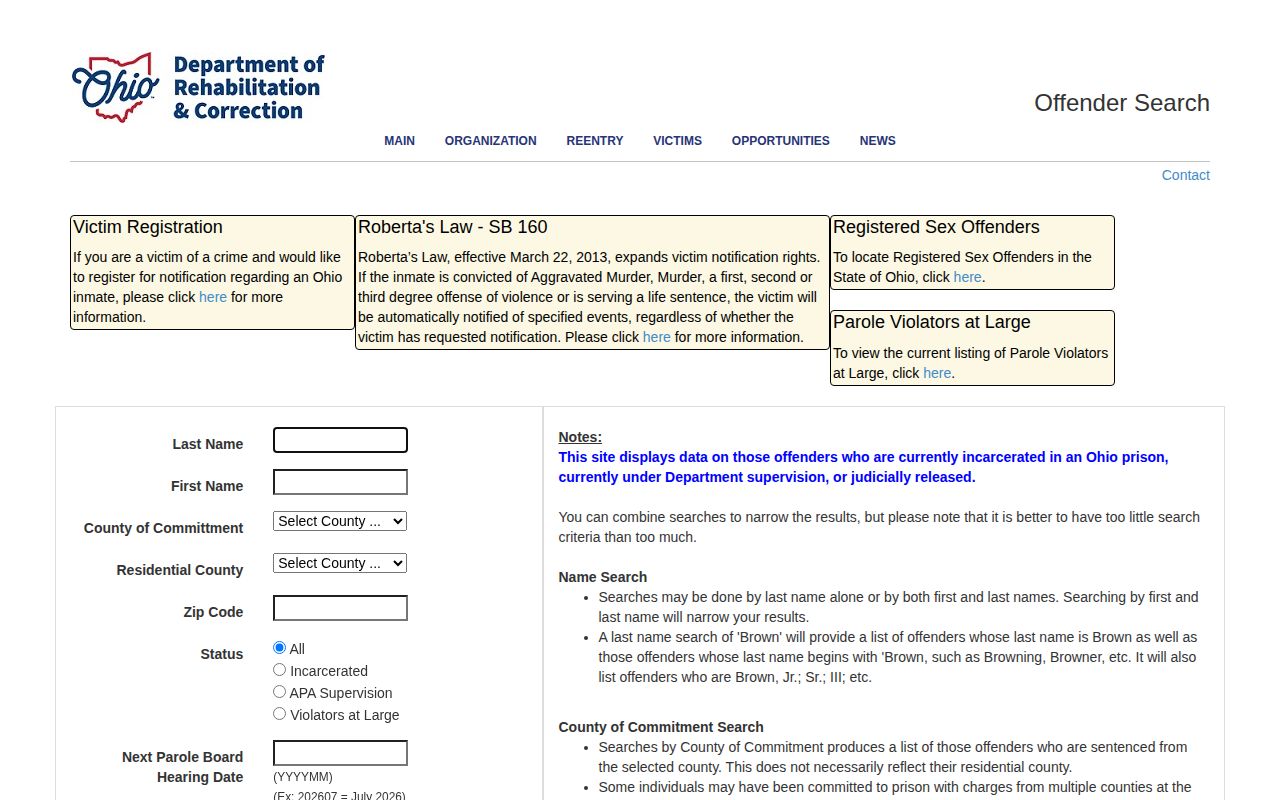
The form’s Released and APA Supervision choices help separate completed state custody from ongoing supervision, while the detail page supplies the docket and date context needed for a sound match.
| Search field | Use | Important limit |
|---|---|---|
| Last and first name | Broad identity search | Open details and verify birth data, offense, and docket. |
| Offender number | Exact state record | Use the letter prefix and six digits without hyphens. |
| County of Commitment | Finds sentences tied to Hocking | Multi-county records can be listed under the first county. |
| Status | Released, APA Supervision, Incarcerated, or VAL | A future date is not a completed release. |
| Hearing month | Finds current Parole Board scheduling | Eligibility and a favorable decision still precede physical release. |
The detail label “Expected Release Date/Parole Eligibility Date” combines two ideas. It may be an expected end marker for a definite sentence or a first eligibility point for an indeterminate sentence. Confirm actual release after the date by checking for Released or APA Supervision, a supervision start, and the latest court or ODRC record. The Hocking projected release page covers that calculation and its limits.
Two Hocking Release Dockets
Hocking felony research often crosses two courts. Hocking Municipal Court is the first path for misdemeanors, traffic cases, and preliminary felony proceedings. A felony complaint may then be bound over to Common Pleas. That transition does not prove dismissal or release. The Common Pleas Internet Inquiry carries felony indictments, pleas, sentencing, judicial release, and community-control entries for ordinary public cases in its published online period.
Match the person and case number, then read the newest journal entry. Look for an order on bond or recognizance, dismissal, jail credit, transport, prison commitment, judicial release, community control, termination, or revocation. A shown bail amount is not proof that bail was posted. Likewise, a sentence does not prove the exact hour the jail executed it.
The Common Pleas source shows the public inquiry used for Hocking release research. Open the official Common Pleas search before comparing the screenshot with a live case.
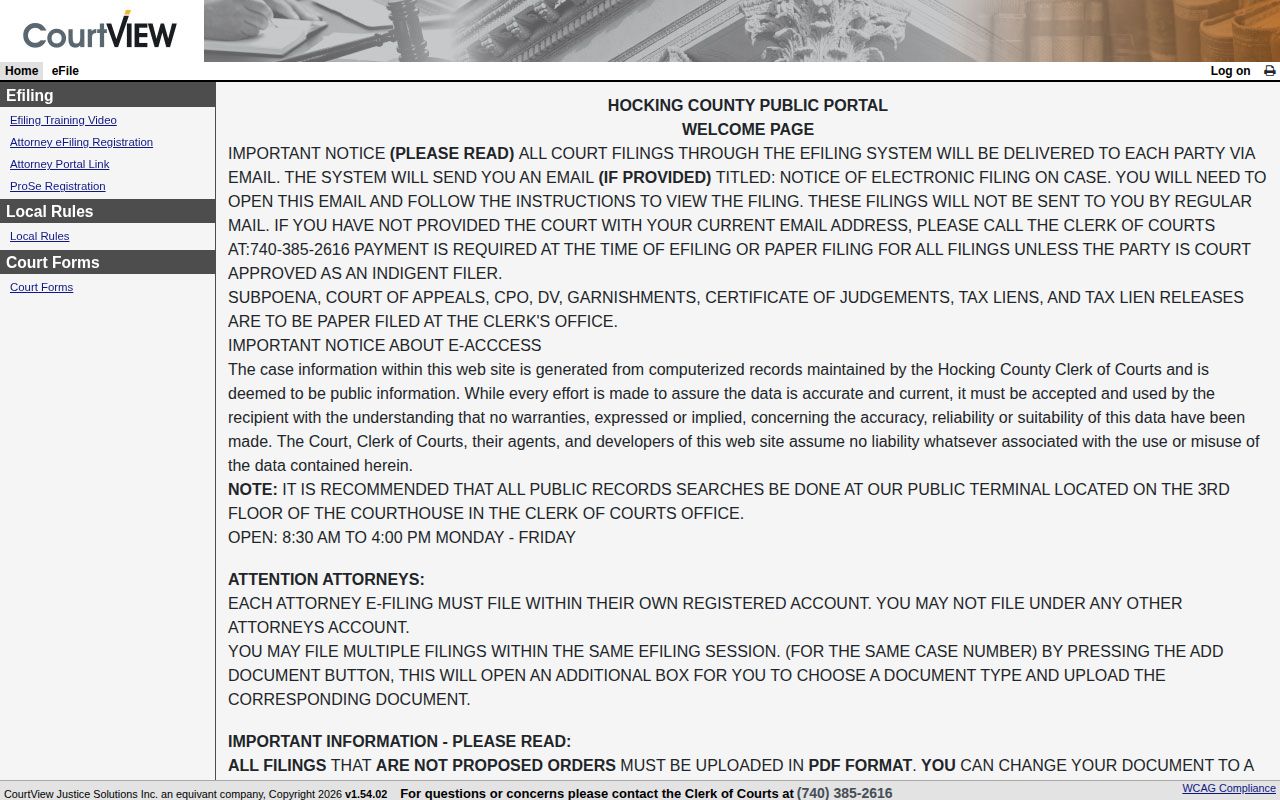
The docket can explain legal authority long after a live roster changes, but the facility record remains the better source for the precise movement time and destination.
Hocking Releases Use a Regional Jail
Hocking County’s official jail source sits outside the county boundary. The Sheriff’s page expressly says Hocking prisoners are housed at Southeastern Ohio Regional Jail and directs inquiries there. SEORJ opened in April 1998 in Nelsonville and serves Athens, Hocking, Morgan, Perry, and Vinton Counties. Its location in Athens County does not make it the wrong facility for a Hocking booking.
The roster mixes those counties. Arresting Agency and court fields are essential, not minor details. A matching name alone cannot establish that a booking belongs to Hocking. The Southeastern Ohio Regional Jail release record page explains the facility-specific verification route and the difference between its current roster and a release archive.
- Discharge
- The documented end of custody at a facility.
- Transfer
- A move to another agency or facility, not freedom.
- Community control
- Court-ordered supervision administered by county probation.
- Parole
- Conditional release for an eligible state sentence under Parole Board authority.
Where Hocking Jail Release Happens
People housed for Hocking do not normally leave from the Sheriff’s office at 25 East Second Street in Logan. The custody site is SEORJ at 16677 Riverside Drive in Nelsonville. No official source reviewed published a routine release hour, exit door, weekend or holiday schedule, property-pickup process, or family waiting area. Call SEORJ at 740-753-4060 before travel and ask about the specific person’s current status and any visitor or pickup instructions the facility can lawfully provide.
This local distinction prevents wasted travel. It also helps explain why a Hocking search can show an Athens County address. The Logan office is an arresting, transport, warrant, and records agency, not a second online housing facility.
Getting Home After Hocking Release
Release in Nelsonville can create a cross-county ride problem for someone returning to Hocking County. Logan Public Transit provides weekday curb-to-curb travel within Hocking County and normally asks for advance booking at 740-385-6999. Same-day service depends on space. Athens On Demand covers Athens County around Nelsonville with advance door-to-door booking at 740-597-2404.
No official direct scheduled route from SEORJ into Hocking County, and no guaranteed jail release ride, was identified. Confirm the release time with the jail first. Then confirm whether each transit provider can serve the pickup and destination. A court order or expected discharge date should not be treated as a fixed pickup appointment.
Verify Hocking Release Supervision
Two systems can supervise a released person. Hocking Common Pleas Probation handles defendants placed on court community control. ODRC’s Adult Parole Authority handles state parole and post-release control. Someone released on bond may have court conditions without being on parole. A person who completed only a local jail term may have no ODRC record at all.
For state supervision, select APA Supervision in the ODRC search and open the detail. Check the start, supervision period, and displayed APA office, while remembering that an address may lag. For local community control, read the sentencing entry and use the Hocking probation office for its own reporting process. The two offices are not interchangeable.
Hocking Release Alerts and Transfers
Ohio VINE can report a General Release, Transfer, Escape, or Death event from a county-jail feeder. ODRC can provide a broader prison and parole event set. Always read the agency and event together. A Transfer alert means custody ended at one facility but may continue elsewhere. VINE is a notice service, not a certified jail discharge record or sentencing docket.
Federal paths are exceptions in Hocking County. The BOP locator covers sentenced federal inmates and can show a release date or that someone is no longer in BOP custody. That does not rule out supervision or another authority. ICE’s locator applies only when immigration custody is plausible, while the U.S. Marshals Service handles federal pretrial custody and transport without a comparable public detailed locator. None replaces an ordinary SEORJ record.
| System | What it can show | What confirms release |
|---|---|---|
| SEORJ roster | Likely current custody and booking fields | Not roster absence; obtain the release or movement entry |
| Hocking courts | Bond, disposition, sentence, judicial release | Final order plus facility execution |
| ODRC | State custody, expected date, Released or APA status | Completed status and supervision start, corroborated as needed |
| VINE | Feeder-reported release or transfer event | Verify with the source agency |
| BOP or ICE | Relevant federal or immigration custody data | Locator result plus court or agency confirmation |
Note: A future date, favorable parole action, roster disappearance, or transfer notice is a lead, not final proof of community release.
Hocking County Release Facility
One detention facility belongs in the Hocking County page set. Southeastern Ohio Regional Jail is the regional county jail serving Hocking prisoners. It is operated for five participating counties at 16677 Riverside Drive, Nelsonville, OH 45764, with inmate information at 740-753-4060. No state prison, federal prison, or dedicated ICE detention facility was identified inside Hocking County. State and federal systems remain fallback jurisdictions, not additional local facilities.