
No Hocking 72-Hour Release List
No official Hocking County Sheriff, Southeastern Ohio Regional Jail, or JDS page offers a 72-hour released-person list. There is no rolling three-day toggle, separate archive, or verified URL for that purpose. The online report available from SEORJ is titled “New Inmate Roster.” It covers people shown in current custody, not people who left during the prior three days.
This missing feed cannot be replaced by scraping court activity. A court may authorize bond, dismissal, community control, or another outcome, but the jail still carries out the custody event. Likewise, a name that vanishes from the roster may reflect a transfer rather than release to the community. A true three-day result needs a date-bounded release or movement record and enough details to isolate Hocking County entries within the regional facility.
Build a Hocking 72-Hour Check
Define the window before opening a search. Write down the start and end date and time, including the time zone. A three-day span that begins late Friday is not the same as three calendar dates. Precise boundaries make a public-record request easier for the custodian to identify and keep the result from blending Hocking bookings with four other counties served by SEORJ.
- Review the SEORJ current roster and record its generated run time. Use arresting agency and court data to identify Hocking-related entries.
- Search Hocking Municipal Court for misdemeanor, traffic, and preliminary felony matters during the period.
- Continue a felony bound over or indicted in the Hocking Common Pleas inquiry. Read the newest journal entry, not just the first charge.
- Compare any pre-registered VINE notice. General Release and Transfer are different events and must be read under the correct feeder agency.
- Request Hocking-related release or movement records for the exact 72-hour boundaries. Follow any receiving-agency entry into that agency’s system.
The shorter Jail Releases: 24 Hours process fits a same-day question. It uses the same official sources but asks for a narrower period and adds local pickup and ride-planning facts.
Hocking Three-Day Roster Fields
No official 72-hour field set exists. The table below identifies what the current regional roster actually shows and which release fields remain absent. Keeping the two groups apart prevents current booking data from being presented as a release log.
| Data group | Fields available or needed | Meaning |
|---|---|---|
| Identity | Name, Jail ID, SID, booking photo | Supports a booking match, not a release finding |
| Case | Charges, court, attorney, next court date | Points to the case record and next event |
| Custody context | Current disposition, total bail, book date | Describes the live entry as published |
| Regional filter | Arresting agency, court, sex grouping | Helps isolate a Hocking-related booking |
| Report context | Generated run date and time | Dates the snapshot but does not state a cadence |
| Missing release fields | Release date, time, reason, destination, receiving agency | Must come from an official release or movement record |
The SEORJ roster source appears below in the form captured for the image manifest.
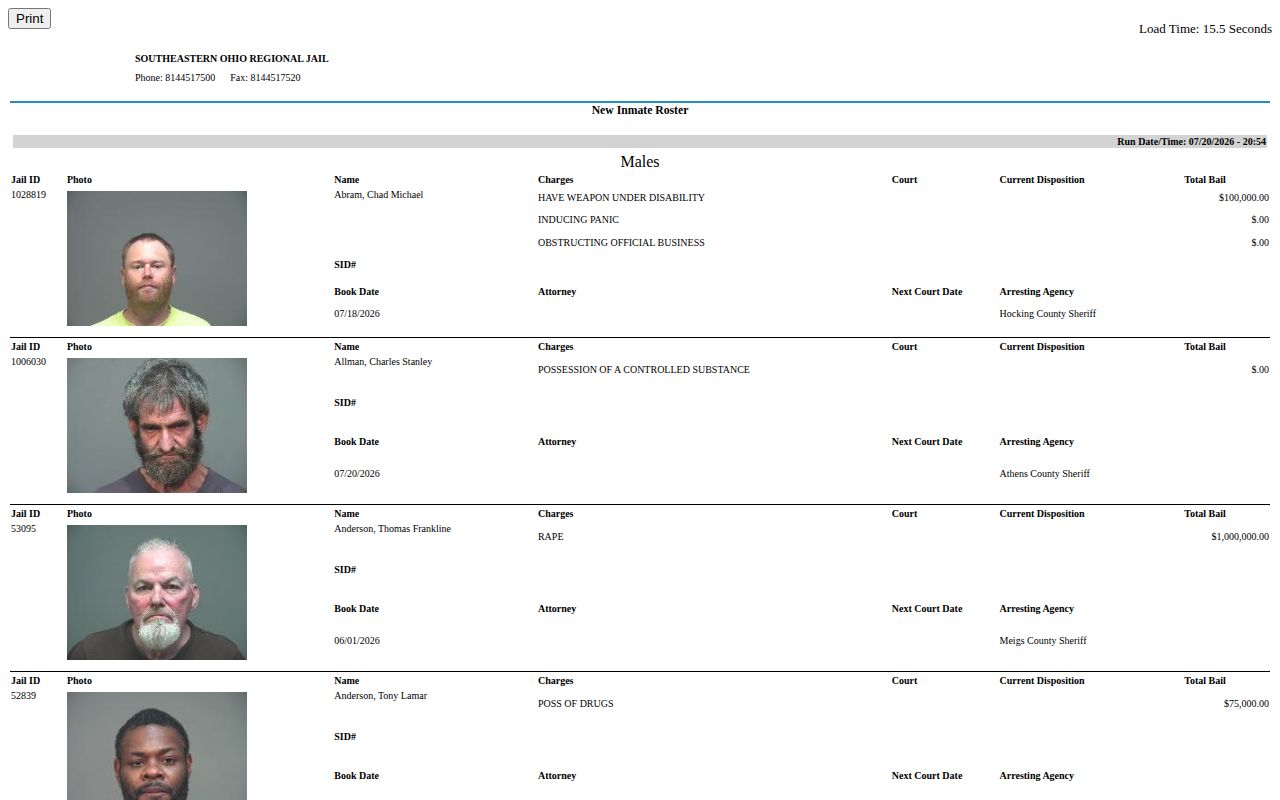
The current roster label, run timestamp, and booking fields show why this source cannot be recast as a three-day release archive.
Note: The roster’s report time dates one current-custody snapshot and does not create a three-day release history.
Hocking Weekend Release Windows
A 72-hour inquiry is useful after a weekend or holiday because it reduces the chance of overlooking an event that occurred between daily checks. It does not solve processing lag by itself. No official source states a SEORJ weekend release schedule, holiday cadence, or fixed time when a release will appear online. The roster run time only proves when that report was generated.
Use exact timestamps rather than asking vaguely for “the weekend list.” If a court order was filed late in the period, the physical event may occur later. Holds, identity checks, transport, and receiving-agency arrangements can also separate a legal order from the time custody ends. The jail movement record is needed to settle the physical event.
Note: A three-day window helps organize the search, but it does not turn a court order or roster change into proof of release.
Hocking 72-Hour Data Quirks
SEORJ serves Athens, Hocking, Morgan, Perry, and Vinton Counties from Nelsonville. Its roster is not a Hocking-only report. The Arresting Agency field and the court or case information are therefore essential. A familiar name alone can point to the wrong county, especially when several people share the same or similar names.
The official regional roster does not publish how long a former detainee remains on the report. Some cells may also be blank. The generated timestamp does not promise hourly, daily, or real-time updates. If a person appeared at the start of the window and was absent at the end, document both checks but do not label the person released. Search the court, inspect VINE if a notice exists, and obtain the release or movement entry.
A movement to ODRC changes the record path. The county docket and SEORJ booking stay useful as history, while ODRC becomes the source for state custody and later released or APA Supervision status. Federal or immigration systems should be used only when a case or transfer record identifies that route.
Note: A receiving-agency entry changes the search path and must be followed before a SEORJ departure is called community release.
Request Hocking Three-Day Releases
For one person, ask for the booking sheet and release or movement record tied to a name, date of birth if known, Jail ID, arresting agency, booking date, and court case. Request the date and time custody ended at SEORJ, the reason or disposition, and the receiving agency or destination when transfer occurred. A precise request can reveal whether the person left for the community or remained in another form of custody.
For all Hocking-related events over 72 hours, provide exact start and end timestamps. Ask the custodian to identify date, manner of discharge, and receiving agency for each responsive entry. Ohio law calls for a jail register containing date and manner of discharge, but the regional arrangement means the requester should ask which office keeps the operative record. The Sheriff’s official policy does not publish a special flat fee for release logs, so request electronic delivery and an advance estimate.
The Hocking County Sheriff contact page confirms the SEORJ referral and provides access to the public-record request route.

The official referral helps send jail questions toward SEORJ while keeping Hocking arrest and agency records with the Sheriff.
Verify Hocking Release Events
Each source proves a different fact. The live roster indicates that a booking appears in current custody at the report time. A court docket can show the legal authority for bond, dismissal, sentence completion, community control, judicial release, or transfer. A VINE event reports what its feeder sent. The release or movement record connects the event to a time, manner, and destination.
- Community release
- Custody ends at the jail and the record supports return to the community, even if court conditions remain.
- Transfer
- Custody ends at SEORJ but continues under a named receiving agency.
- Discharge
- The formal recorded manner in which custody ended in the relevant jail or corrections system.
- APA Supervision
- An ODRC status supporting release from state prison into Adult Parole Authority supervision.
A General Release notice should be confirmed with the feeding agency when precision matters. A Transfer notice must be followed to the next custodian. The Ohio Department of Rehabilitation and Correction does not cover a person whose whole custody was an ordinary SEORJ stay, and a future expected release date does not prove an event occurred.
Note: The agency, event label, and execution record must agree before a Hocking custody change is described as a confirmed release.
Find One Hocking Release
A list request and a named-person search are not the same job. A three-day log seeks every responsive Hocking-related movement within set boundaries. A named-person inquiry follows one custody path across the jail, courts, VINE, state corrections, or another receiving agency. Matching the person by case number, date of birth, Jail ID, or offender number reduces false matches.
The Hocking County released inmate search explains the complete path for a known person. It also distinguishes a county-jail event from state-prison, federal, and immigration outcomes. If no public result appears, check spelling, aliases, court transitions, remote-access limits, and whether the record may be sealed or otherwise restricted. Absence does not prove release or any other result.
These sources support release verification, personal knowledge, notifications, court processes, and records requests. Verify each key detail with the agency or court that created the record.