
Hocking County Parole Versus Probation
Parole, post-release control, and probation can all require a person to follow rules in the community. They do not arise from the same authority. Ohio's Adult Parole Authority, part of the Ohio Department of Rehabilitation and Correction, oversees state parole and post-release control. The Hocking Common Pleas Probation office supervises defendants whom the Common Pleas Court places on community control. The judgment entry and the agency named in it are the best starting points.
A person released from Southeastern Ohio Regional Jail on bond may have pretrial terms without being on parole. Someone who finishes a misdemeanor jail term may never enter ODRC data. In contrast, a person leaving an Ohio prison may appear as APA Supervision even when friends call that status probation. These labels affect which office can confirm the record and which system shows the end of supervision.
| Supervision | Source | Hocking County verification |
|---|---|---|
| Parole | Parole Board action after an eligible state sentence | ODRC offender detail and APA office field |
| Post-release control | State supervision following prison release | ODRC status, supervision start, period, and APA office |
| Community control | Common Pleas Court sentence in the community | Sentencing entry and Hocking Common Pleas Probation |
| Pretrial conditions | Court order while a case remains open | Latest Municipal or Common Pleas docket entry |
- Parole
- Conditional community release granted for an eligible state sentence.
- Probation
- A common term for court supervision; Ohio court records often use community control.
- Post-release control
- APA supervision that follows release from a state prison term.
- Discharge
- The formal end of the supervision term, not merely the end of confinement.
Verify Hocking County Post-Release Supervision
First identify whether the case ended in a local court order or a state prison commitment. That one fact prevents many false matches. Hocking County Municipal Court records are useful for misdemeanor and preliminary felony matters. Common Pleas records show felony sentencing, community control, prison commitment, judicial release, termination, or revocation. ODRC covers the state-prison track, not an ordinary SEORJ-only stay.
- Find the latest court judgment and read the sentence, not just the charge or bond amount. Note whether it names community control, prison, judicial release, parole, or post-release control.
- For a state case, search ODRC by name or offender number. Use County of Commitment = Hocking when helpful, then open the matching detail.
- Choose the APA Supervision status filter for parole or post-release control. Compare the offender number, docket, date of birth, offense, and county before relying on the result.
- Read the supervision start, period, and APA office. ODRC warns that residential data can lag and that a listed term may relate to a prior offense.
- For court community control, confirm the judgment through the Hocking Common Pleas docket and ask the local probation office only about its own reporting process.
The live agency record matters more than an old office list. A released person may report to an APA office outside Hocking County, and a residential-county filter reflects the last recorded address. For the wider release-record chain, the Hocking County released inmate search explains how the jail record and final court entry establish what happened when custody ended.
Note: A future parole date, favorable hearing result, or missing jail-roster name does not prove that physical release occurred.
Hocking County Community Control Office
Hocking Common Pleas Probation handles court-ordered community control. Its official page says officers use reporting interviews and home visits to supervise defendants placed under the office by a judge. That role is distinct from state APA supervision. The office is not the custodian of the SEORJ release log, and it cannot verify parole merely because a person is no longer in the regional jail.
Hocking Common Pleas Probation
Administration: 740-380-4123 ext. 1
Supervisor: Casey Jones, ext. 4
Common Pleas Probation contacts
The published page lists officer extensions as well. Use the court entry to select the right contact. No verified current Hocking APA street address or public walk-in schedule was found, so state-supervision inquiries should follow the APA office shown on the live ODRC offender detail rather than an older directory.
The official Hocking County probation page shows the local office and its contact structure.
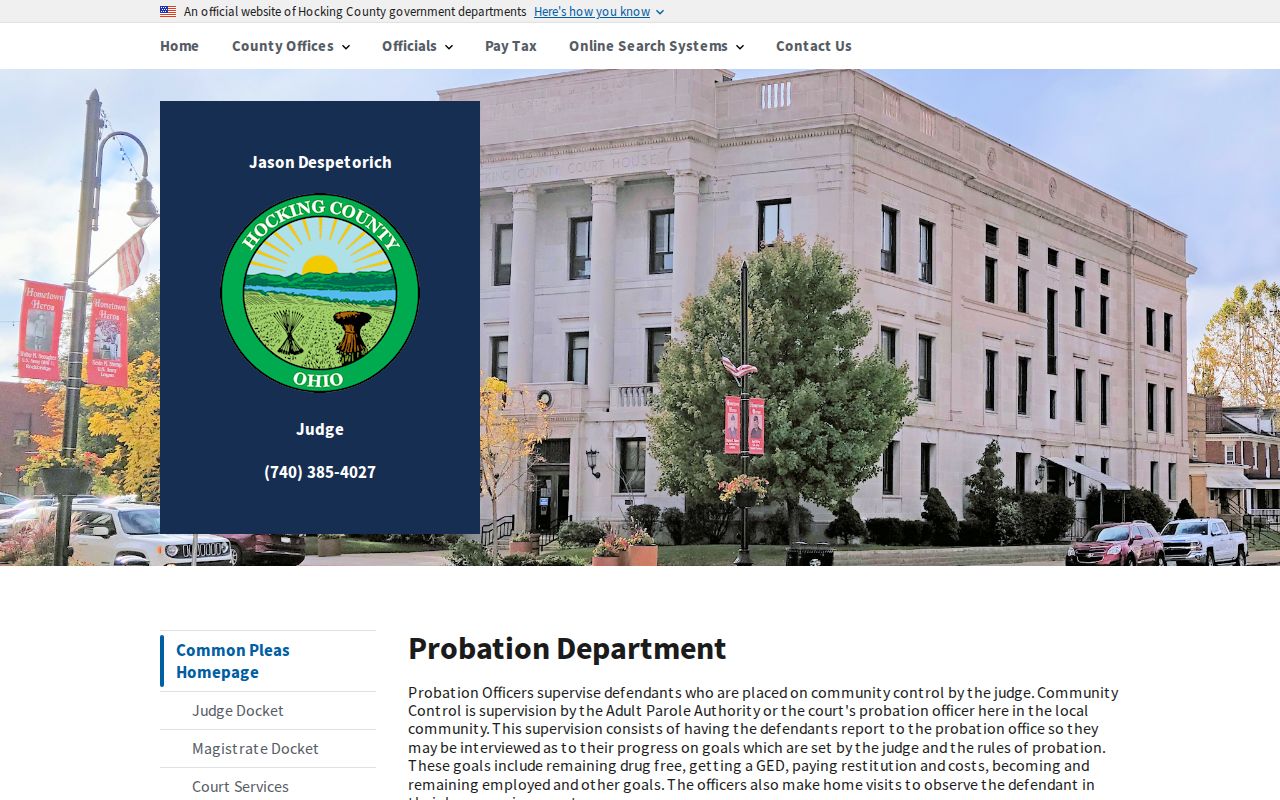
This local source helps separate a court community-control record from parole or post-release control maintained by ODRC.
Which Hocking Supervision Office Applies?
A "no record" answer from one office does not establish that a Hocking County person has no supervision. The local probation department and state APA maintain separate caseloads. Community control can follow a Hocking Common Pleas sentence without an APA listing. Parole or post-release control can appear in ODRC with an APA office that has no connection to the county probation staff.
Read the sentencing entry first. If it orders community control, follow the Common Pleas Probation contact. If the person served a state prison term, open the ODRC detail and look for Released or APA Supervision, a supervision start, period, office, and conditions. A judicial release can involve both an ODRC released status and court-controlled terms, so the Common Pleas judicial-release entry remains essential.
This local split is the key to a sound Hocking County probation and parole check. Neither office should be asked to interpret the other's record. VINE may report a custody or supervision event, but it is a notification layer rather than the court judgment or official supervision file.
Note: Match the supervising agency named in the court or ODRC record before calling, since similar everyday labels hide different legal statuses.
Hocking Parole Absconder Records
ODRC provides a statewide Violators at Large list for people whom APA has declared at large. The result may show a photograph, offender number, birth date, offenses, and the declared-at-large date. Use those fields to distinguish people with similar names. The listing is a supervision lead, not a new SEORJ booking and not proof that the person has been returned to custody.
Do not attempt apprehension. ODRC directs the public not to confront a listed person. Law enforcement must verify any warrant through LEADS or NCIC.
A violation can involve failure to report or another alleged breach of conditions, but the public listing does not provide a full case file. If the person later appears in a jail roster, that separate custody record must be checked on its own facts. A VAL entry also differs from a Hocking court probation revocation, which is documented through the Common Pleas docket and local probation process.
The official ODRC Violators at Large search displays the available post-release supervision fields and its safety warning.
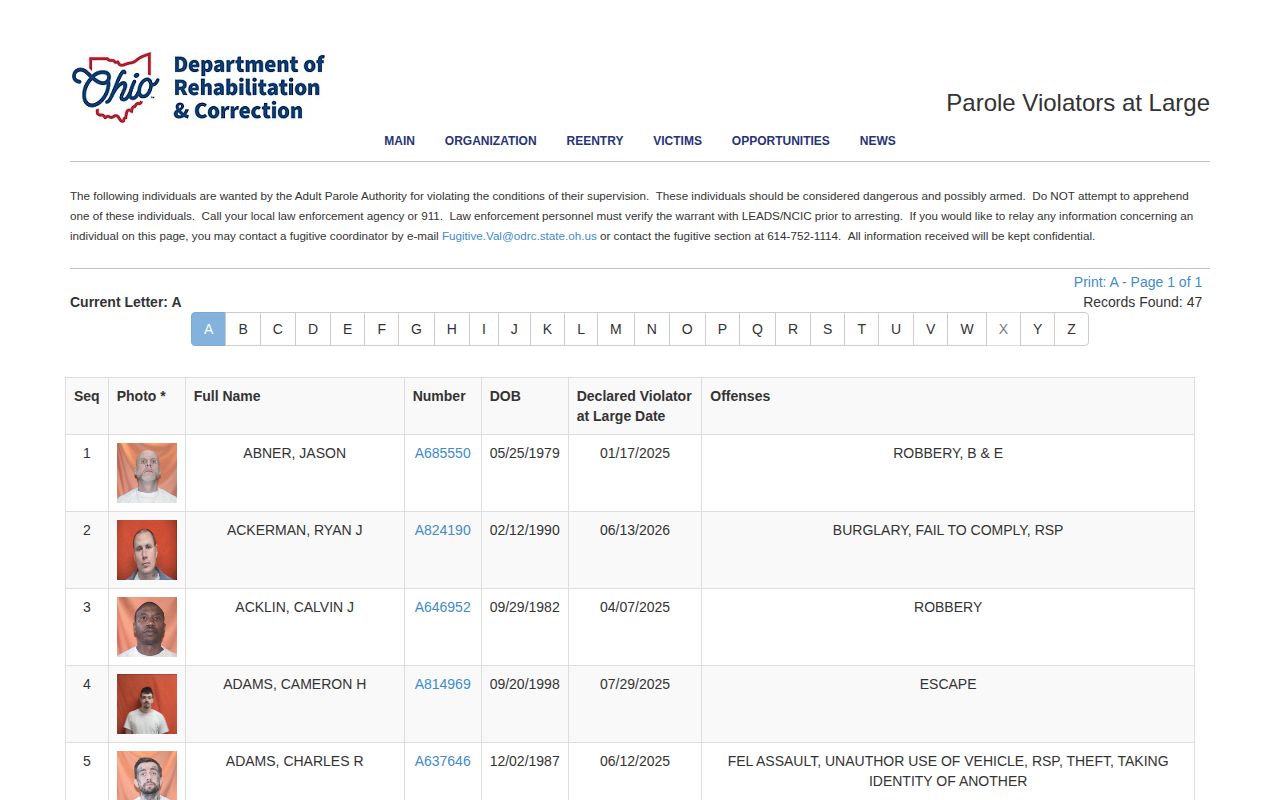
The warning beneath the search is why an online result must be treated as an APA lead and verified by law enforcement.
Hocking Parole Hearings and Conditions
The Ohio Parole Board handles discretionary parole for eligible state sentences. Its 2024 handbook describes monthly release-consideration hearings held by institutional video. The practical public calendar is the ODRC offender search: enter a Next Parole Board Hearing Date in YYYYMM, add County of Commitment = Hocking, and open each matching detail. No separate current all-case calendar was verified.
A hearing month is not a release date. At first eligibility, the Board can recommend parole or continue the matter. A favorable action may lead to a Parole On or After date, while a projected release date can depend on a condition or program. New information can cause the Board to reconsider, modify, rescind, or maintain an earlier decision. Physical release must still be shown by a later status or supervision start.
Conditions vary by sentence and order. At a high level, supervision can require reporting, compliance with instructions, and observance of court or APA terms. A suspected violation may result in a court revocation process or an APA response, depending on which system controls. The public ODRC detail can provide conditions, but it also warns that some displayed supervision may relate to a prior offense.
Parole decisions can be checked through the individual detail, Board minutes or orders, and a focused records request. OAC 5120:1-1-36 identifies determinations, orders, minutes, and certain hearing material as public while allowing the Board to withhold listed material when disclosure risks harm, security, or a fair hearing. No separate name-indexed Hocking County decision archive was verified. Search the person and hearing month first, then request the specific Board record if the result needs more context.
Hocking County Supervision Discharge
Release from confinement and discharge from supervision are separate events. A person can leave prison and begin parole or post-release control, or leave SEORJ and begin court community control. The release date marks the custody change. Discharge marks the end of the later supervision obligation.
For APA, check the ODRC detail for the status, supervision period, and current office. ORC 2967.28 supplies the statutory framework for post-release control. Ohio VINE can provide some ODRC events, including release from parole, but an alert should be checked against the originating agency record. For local community control, read later Hocking Common Pleas entries for termination, completion, modification, or revocation. Do not infer discharge merely because a term seems old or a name is hard to find online.
Ohio law also limits what the public can obtain from internal ODRC files. ORC 5120.21 permits a defined public subset that includes name, convictions, photograph, supervision status, custody place, and disciplinary history, while other inmate and APA material may remain restricted. Use the public offender detail, the court docket, and a narrow records inquiry for the status that each source actually controls.
Note: Confirm discharge with the supervising authority; a completed jail or prison term can still be followed by active community supervision.