
Hocking Projected Versus Actual Release
ODRC uses the combined label Expected Release Date/Parole Eligibility Date. The slash signals that the field can mean different things. For a definite prison term, it may show the agency's current calculated end marker. For an indeterminate or life sentence, it may show when the person first becomes eligible for Parole Board review. Eligibility does not promise release, and a Board decision does not prove that a person has left the institution.
County custody follows another track. A pretrial detainee at Southeastern Ohio Regional Jail has no sentence-based release date. Bond, recognizance, dismissal, a court order, or a hold can change custody. A sentenced jail term is read from the court entry, credit information, and SEORJ release record. The ODRC field applies only after a state commitment, not to every person arrested in Hocking County.
Scheduled is not actual. A projected or eligibility date estimates a legal milestone. Actual release requires a completed custody event, such as an ODRC released status, APA supervision start, or jail discharge record.
The distinction also matters when a transfer occurs. Leaving SEORJ for ODRC, another jail, federal custody, or immigration custody ends the first facility stay but does not mean community release. The receiving agency and legal authority belong in the verification chain.
Find a Hocking County Release Date
Start with the last agency that held the person and the sentence shown by the court. Hocking Municipal Court generally handles misdemeanors and preliminary felony matters. Hocking Common Pleas records show felony sentencing, prison commitments, judicial release, and community control. The custody system chosen next must match that disposition.
- Open the latest court journal entry. Identify whether the person is awaiting trial, serving a local jail sentence, or committed to ODRC.
- For an ODRC commitment, use the official Ohio offender search. Search by name with County of Commitment = Hocking, or use the complete offender number.
- Open the matching detail and compare offender number, birth date, committing county, docket, offense, admission, institution, sentence, and jail-time credit.
- Read the exact Expected Release Date/Parole Eligibility Date label with the sentence type, hearing data, and any POA or PRD field. Do not detach the date from those qualifiers.
- For an SEORJ-only sentence, use the final court entry and request the jail release or movement record. A live roster is a current-custody clue, not a date calculator.
- After the expected day, verify a completed event through ODRC status and supervision start or through the regional-jail discharge entry.
A full name alone can produce a bad match. ODRC notes that a county filter may reflect the first county on a multi-county record, and its public detail warns that sentence data may be incomplete. The Hocking County release-record search path provides the court and records-request steps for a person who never entered state prison.
Note: Use few search fields first, then confirm the result with the docket and offender number before relying on any displayed date.
Hocking County ODRC Date Fields
An ODRC detail can contain several dates and results that describe different stages. The effective sentence date and aggregate sentence begin the calculation. Jail-time credit reflects qualifying custody already served. The expected release or parole eligibility field supplies the public milestone. Hearing and review data then describe discretionary Board activity, while supervision start is evidence that a later community-supervision phase began.
| ODRC field | What it can show | What it does not prove |
|---|---|---|
| Effective sentence date | When the displayed sentence calculation begins | The day physical custody will end |
| Jail Time Credit | Qualifying confinement credited toward the term or eligibility | Program-earned credit |
| Expected Release Date/Parole Eligibility Date | A calculated end marker or first eligibility point | A guaranteed departure |
| Next hearing or review | A scheduled Board milestone | A grant of parole |
| POA/PRD | A Parole On or After or conditioned projected date | Final physical release |
| Supervision start | Evidence that APA supervision began | Discharge from supervision |
The official ODRC search form includes filters for Released, APA Supervision, Violators at Large, county, and hearing month.
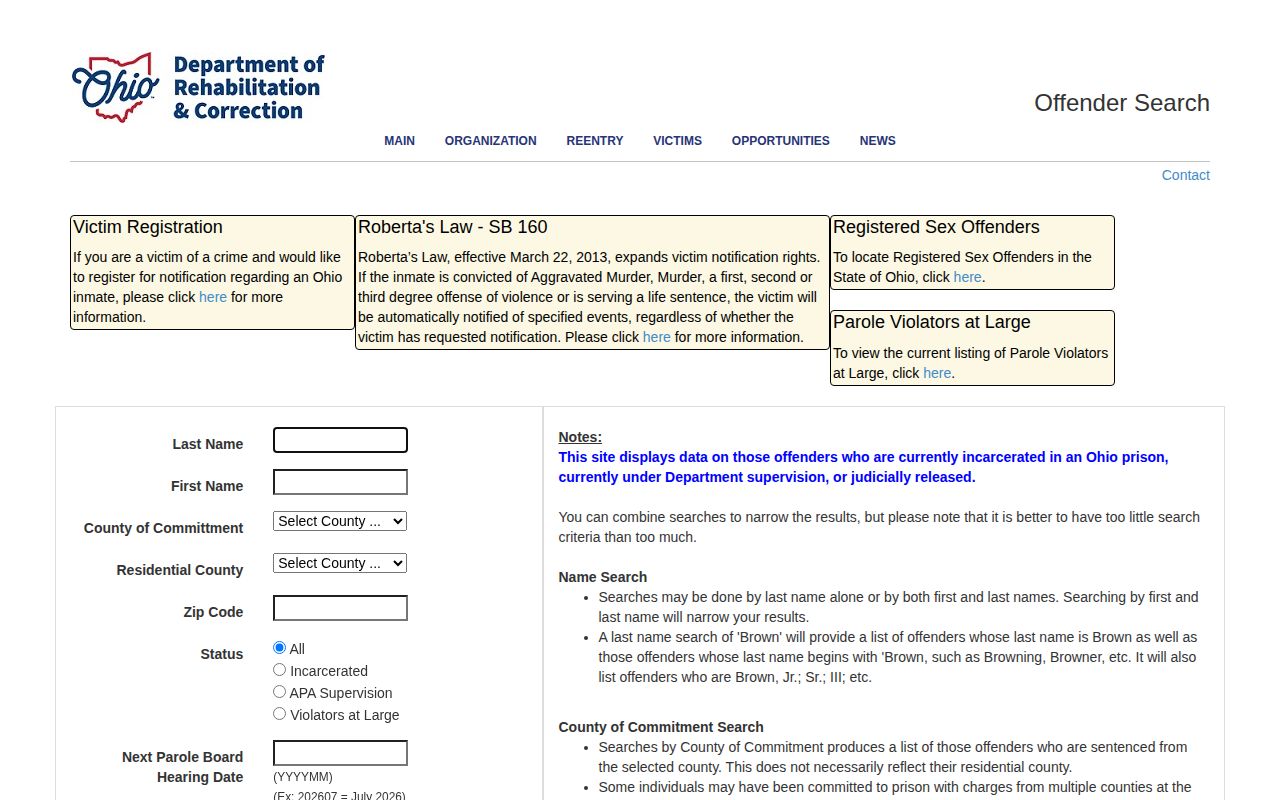
Those filters separate future date research from actual released status and active post-release supervision.
Hocking County Earned Release Credit
ORC 2967.194 permits earned credit for eligible people confined on or after April 4, 2024 who take part in qualifying programs or activities and meet statutory requirements. Depending on the category, provisional credit may accrue at one or five days for each completed month. Limited completion credit may also apply. ODRC reviews the credit, and it can be denied or withdrawn for rule violations.
The ordinary participation and completion credit is generally capped at fifteen percent of the stated term. Certain diploma or program completions can yield ninety days or ten percent, whichever is less, subject to the statute. The law excludes several kinds of terms and offenses, including non-reducible terms, murder sentences, life without parole, specified Chapter 2971 terms, and described sexually oriented offenses. OAC 5120-2-06 implements the earned-credit framework across sentencing eras.
That ceiling is why an "85 percent" shorthand sometimes appears. It is not a rule that every Ohio prisoner leaves after serving that share. Mandatory terms, exclusions, indefinite sentences, parole cases, judicial release, transitional control, and county-jail sentences follow different law. Apply the sentence type and current ODRC calculation instead of a homemade percentage.
ORC 2967.191 addresses jail-time credit for qualifying custody tied to the offense, including certain pretrial detention and time awaiting transport. That credit is time already served. It is distinct from credit earned through later programs or conduct. No uniform SEORJ weekend adjustment or Hocking County jail good-time formula was verified.
What Changes Hocking Release Dates?
A public date can move because the facts behind the sentence change. ODRC performs the official calculation. The public should not add and subtract credits from a docket and publish a private estimate, especially where consecutive cases, mandatory parts, or a later court correction may not be clear from one screen.
| Factor | Possible effect | Best record to check |
|---|---|---|
| Jail-time credit | Reduces the applicable prison term or eligibility date for qualifying prior custody | ODRC detail and sentencing entry |
| Earned credit | May reduce an eligible term within statutory limits | Current ODRC calculation |
| Credit denial or withdrawal | Can move the expected date later | ODRC record and applicable rule |
| New or corrected sentence | Can alter aggregate, concurrent, consecutive, or mandatory time | Latest court entry and ODRC detail |
| Detainer or agency hold | May send the person to another authority rather than the community | Movement record and receiving agency |
| Parole Board action | May continue review, set a later marker, or approve a conditioned step | Latest hearing result and Board record |
| Judicial release | Can move an eligible prison sentence into court-controlled conditions | Common Pleas judicial-release entry |
Additional cases are especially important. A person can reach one expected date yet remain held under another county, federal order, immigration process, or pending matter. The first facility's release or movement record should name the receiving agency when a transfer occurs.
Note: A hold or transfer may end custody at one facility without producing release to the community on that date.
Hocking County Parole Date Milestones
ORC 2967.13 sets first eligibility points for specified life and indeterminate sentences, with detailed exclusions and exceptions. Eligibility means the person may be considered. It does not compel the Board to grant release. ORC 2967.132 provides a separate route for qualifying people who were under eighteen at the offense, and life-without-parole or other designated terms must not be treated as ordinary eligibility cases.
The Ohio Parole Board handbook says a finalized recommendation can lead to a Parole On or After date. It also describes a less common PRD tied to an unmet program or condition. OAC 5120:1-1-10 authorizes a projected release date within the rule's limit and provides for publication in official minutes. A continued hearing date instead means the Board will reconsider later.
Qualifying indefinite sentences use another framework. ORC 2967.271 addresses minimum and maximum terms and a rebuttable presumption of release at the end of the minimum term. The statute permits continued confinement under defined findings and procedures. It should not be reduced to one fixed date without reading the sentence, ODRC detail, and any hearing action. Old-law and life cases instead turn on parole eligibility and Board review, while definite sentences use their own current calculation.
For a Hocking County commitment, search ODRC with the county and hearing month, then open the individual detail. Read the latest hearing or review type and result. A proposed action can still change before physical release. After a favorable decision, return to the record for Released or APA Supervision and a supervision start.
The official Ohio parole eligibility statute shows why sentence details must be checked before treating an eligibility date as an exit date.
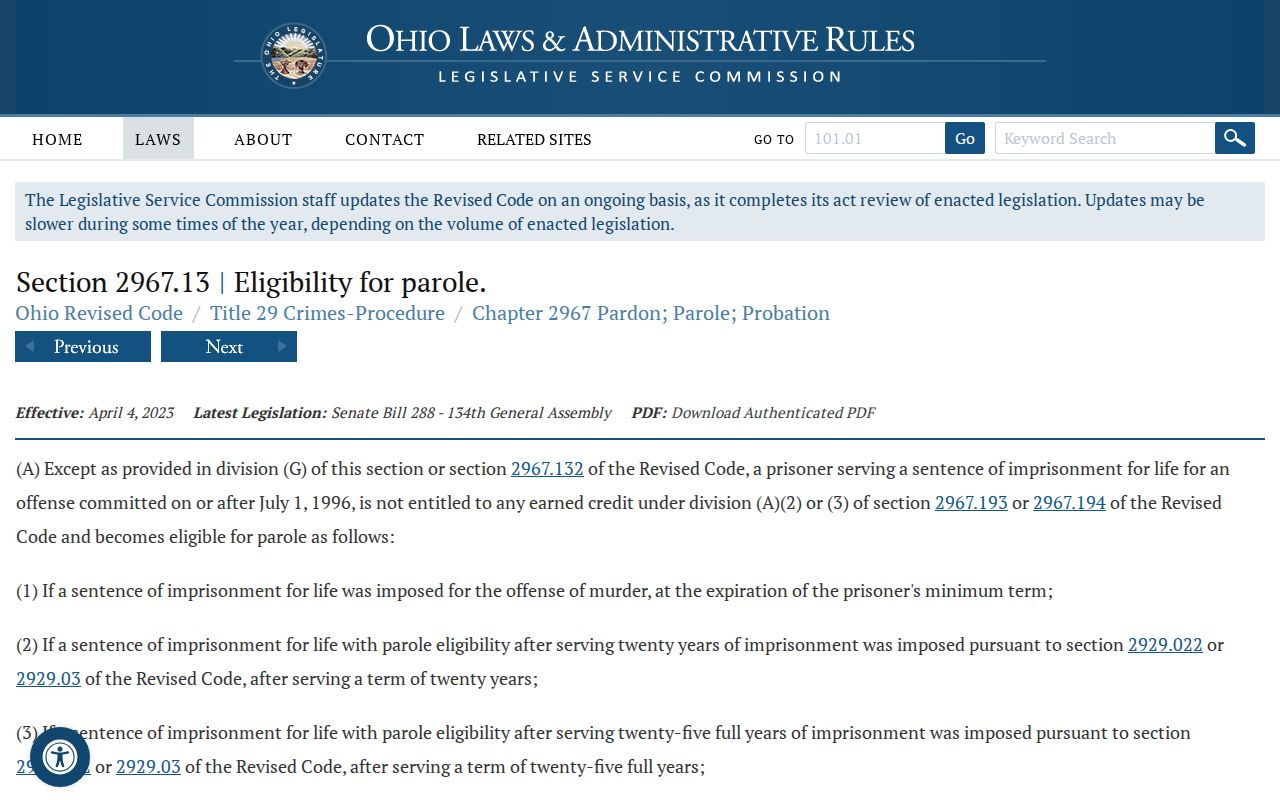
The statute supplies legal eligibility points, while ODRC supplies the current person-specific date and status.
Confirm a Hocking County Release
After the projected day passes, check the system that held the person. For a state prisoner, open the ODRC detail and look for a released status or APA supervision with a start date and office. If the status remains incarcerated, the earlier date did not become a completed release. Questions about a suspected ODRC field error can be directed to Central Records at the mailing address printed on offender details.
For a stay at the Southeastern Ohio Regional Jail, use the final Hocking court order and request the regional-jail discharge or movement entry. Under Ohio jail rules, an interagency release record should identify the receiving officer and agency, time and date, and legal authority. Those facts distinguish community release from transfer. A missing name on the live current roster does not perform that work.
Ohio VINE can send a General Release or Transfer event when a person was registered in time. The event must be read literally and checked with its source. The Hocking County VINELink inmate search explains how the county-jail and ODRC feeds differ. VINE is not a certified discharge record and should not control a legal deadline.
When precision matters, compare the ODRC status or SEORJ record with the latest court entry. That pairing answers both sides of the question: which authority allowed the custody change, and when the holding agency carried it out.
Note: Verify the completed event after the projected day; expected, eligibility, hearing, transfer, and actual release dates are not interchangeable.